
USA Cell / WhatsApp: +1.480.635.2965
YouTube Shorts: Blue Sky Cabo Shorts
F Dock, Centro, Marina, 23450 Cabo San Lucas, B.C.S., Mexico
If you are planning a Cabo fishing charter during September and want a species that combines explosive strikes, brilliant colors, aggressive feeding behavior, and the possibility of several fish becoming active around the boat at the same time, Cabo dorado fishing deserves a place near the top of your list. September brings warm offshore conditions to Cabo San Lucas, and dorado can be found wherever baitfish, floating vegetation, current edges, birds, and other signs of marine activity create productive feeding opportunities, making the quality of the day’s fishing depend heavily on how well the captain reads those changing conditions rather than simply following a predetermined route.
Dorado are especially appealing because the fishing can transform from a quiet search across open Pacific water into an exciting period of nonstop action when the right combination of forage and predator activity is discovered. An experienced crew may spend considerable time watching the horizon, evaluating water color, tracking bird activity, looking for floating structure, and checking the behavior of the trolling spread before suddenly changing course toward an area that appears promising. For anglers visiting Cabo San Lucas, that process is an important part of the experience because the eventual dorado bite is often the result of numerous small decisions made offshore rather than a simple matter of arriving at a famous fishing spot.
Why Cabo Fishing in September Can Put Dorado on the Radar
Cabo fishing in September occurs during a warm-water portion of the seasonal cycle when offshore conditions can support substantial predator activity, although the exact location and intensity of that activity can change from day to day. Dorado are highly mobile pelagic predators that follow available food, which means a productive area can develop around baitfish, floating debris, weed lines, current boundaries, or other features that concentrate marine life. The important distinction for anglers is that a captain is not merely searching for “dorado water,” because there is no single type of water that guarantees the presence of these fish. Instead, the crew is looking for a combination of clues that suggests an area deserves attention, and those clues can include birds working over bait, visible forage near the surface, floating objects surrounded by smaller fish, changes in water color, temperature transitions, or current movement that appears capable of concentrating food.
September can also produce opportunities for several other pelagic species, including yellowfin tuna, wahoo, sailfish, striped marlin, and blue marlin, which means a Cabo private fishing charter can retain flexibility while keeping dorado as the principal objective. If the captain encounters a productive dorado situation, the crew can concentrate on that opportunity, while a significant change in offshore activity may justify adjusting the plan when another worthwhile species becomes available.
How Cabo Fishing Captains Read the Ocean for September Dorado
- The search for dorado begins with observation, and experienced Cabo fishing captains develop a habit of constantly scanning the ocean for small changes that could indicate where predators are feeding.
- A captain may notice a narrow line of floating vegetation extending across the surface and then look beyond the vegetation to determine whether birds are working nearby, whether baitfish are visible, and whether the current is creating a natural edge along the line. The vegetation itself is not necessarily valuable because of the plant material; instead, it can be important because small organisms and baitfish may gather around it, potentially creating an attractive feeding environment for larger predators.
- Floating debris receives similar scrutiny.
- A log, piece of natural debris, or other floating object may have nothing beneath it, while another object can become associated with a concentrated group of baitfish and predators. The captain therefore evaluates the surrounding water rather than assuming that every floating object deserves the same amount of fishing time.
- This is one of the reasons a professional Cabo San Lucas fishing charter can provide an advantage over simply knowing the name of a fishing location, because the ocean changes constantly and the ability to interpret those changes is often more valuable than a static list of coordinates.
What Cabo Fishing in September Reveals About Dorado Behavior
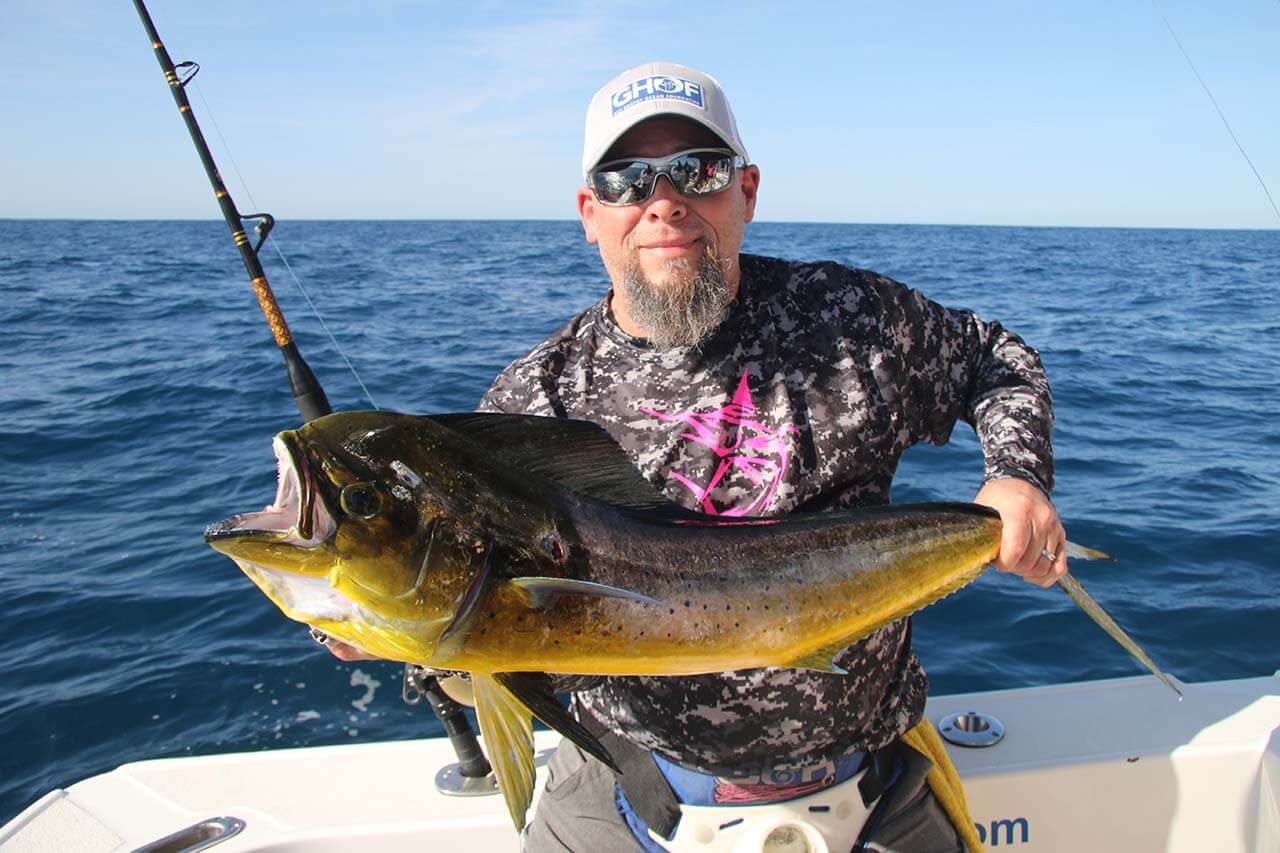
- Dorado are among the most visually exciting fish encountered during Cabo fishing, partly because their feeding behavior can be aggressive and partly because their coloration becomes spectacular when they are active.
- A school may remain around floating structure or move along a weed line while searching for forage, and when one fish attacks a lure or bait, other dorado may remain close enough for the anglers to see them beneath the surface. That behavior can create an opportunity for several anglers to participate in the action, although the crew must coordinate the cockpit carefully because multiple hooked fish can quickly create difficult line angles.
- The captain’s job changes once a school is located because the boat is no longer simply searching across open water. The crew now needs to keep the anglers in a position where additional fish can be presented with bait or lures while the mate handles the hooked fish, prepares landing equipment, and prevents lines from becoming tangled.
- For an angler, this can be one of the most enjoyable aspects of Cabo dorado fishing, because the fish are not only strong enough to provide an entertaining fight but can also remain visible and active around the boat.
Why Cabo Fishing in September Pays Close Attention to Baitfish
- Baitfish are one of the most important pieces of information available to a captain pursuing dorado because predators have little reason to remain in an area where food has disappeared.
- During September fishing around Cabo San Lucas, the crew may watch for baitfish breaking the surface, small fish scattering ahead of predators, flying fish moving away from feeding activity, or concentrations of forage associated with birds and floating structure. These signs can help establish whether a particular area is worth investigating, although the presence of bait does not automatically mean that dorado are present.
- Bird behavior can add another layer of information.
- When birds repeatedly dive into a specific area, the captain may investigate because predators can push bait toward the surface, creating feeding activity visible from above. The direction of the birds and the way the feeding activity moves can also provide clues about where the bait and predators are traveling.
- This is why Cabo fishing requires more than simply putting a lure into the water and waiting.
- The captain is attempting to understand an entire feeding system, and the baitfish are at the center of that system.
How Cabo Fishing in September Uses Floating Structure
- Floating structure can become a valuable part of a Cabo fishing strategy when it appears to be associated with forage and predator activity.
- Dorado may investigate floating objects because the surrounding area can contain smaller fish, crustaceans, or other organisms that provide feeding opportunities. The captain may approach from a particular angle so that anglers can fish around the object while accounting for wind, current, boat drift, and the movement of the fish.
- The difference between a productive piece of floating structure and an unproductive one may not be obvious to a passenger.
- An experienced captain may notice that one object is surrounded by bait while another has no visible activity, or that one sits along a current edge where forage appears concentrated. Those observations can influence whether the boat stays, makes another pass, or continues searching.
- When dorado are present, the mate may prepare several rods because the fish can become active quickly once the first presentation reaches the productive area.
- That preparation matters because dorado fishing can move from observation to action in a matter of seconds.
Cabo Fishing in September and the Value of Weed Lines
- Weed lines deserve attention during Cabo fishing in September because floating vegetation can create edges where baitfish and smaller marine organisms find favorable conditions.
- The most interesting weed lines are not necessarily the largest ones, because the captain is looking for evidence that the vegetation is actually functioning as a feeding area. Baitfish, birds, current movement, and visible predator activity can make one section more interesting than another.
- The boat may work along the edge rather than driving directly through it, allowing the trolling spread to cover water where dorado may be traveling.
- The current can also influence how the vegetation forms.
- A strong current may create a longer, cleaner edge, while weaker movement can leave vegetation scattered across a wider area. These differences can influence how the captain chooses to search.
- For anglers, the important lesson is that a weed line is not simply something the captain happens to notice; it can become a fishing tool when it provides clues about where the food chain is concentrated.
Why Cabo Fishing in September Can Use Trolling to Locate Dorado
- Trolling is particularly useful during the search phase because it allows a Cabo fishing charter to cover substantial water while presenting multiple artificial lures at different distances and angles behind the boat.
- The trolling spread can be adjusted according to the conditions, and the captain watches both the lures and the surrounding ocean for additional clues. Lure color, size, running depth, leader selection, speed, and position can all influence the presentation, although the crew’s choices should be based on the current fishing situation rather than a rigid formula.
- When a dorado strikes, the bite provides information.
- The captain now knows that a predator was willing to attack a particular presentation at a particular location, and if another fish appears behind the lure, the crew may have discovered a concentration rather than an isolated fish.
- That can lead to a change in strategy.
- Instead of continuing straight ahead at the same speed, the captain may work the area more carefully, turn back through productive water, or introduce live bait if the fish are remaining close to the boat.
- The ability to make that transition is one of the defining advantages of a professional Cabo charter.
Cabo Fishing in September and Live Bait for Active Dorado
- Live bait provides another important option when dorado are located, particularly when the fish are feeding naturally around the boat or along a productive edge.
- A healthy baitfish presents a natural movement that can be difficult for a predator to ignore, and the mate’s job includes maintaining the bait and presenting it properly so that it remains attractive.
- Blue Sky Cabo includes live bait with its fishing charters, allowing the crew to have natural bait available as part of the day’s fishing strategy.
- The presence of live bait does not mean that trolling becomes irrelevant.
- Instead, the two approaches can complement one another.
- Trolling can help locate fish across a broad area, while live bait can become useful after the crew has identified an active concentration. The captain may decide which presentation makes the most sense according to the fish’s behavior, the amount of bait available, and the way the dorado are responding.
- This flexible approach prevents the trip from becoming locked into one technique simply because it was selected before leaving the marina.
How Cabo Fishing in September Matches Dorado Tackle to the Situation
- Dorado are fast fish, and their speed means that tackle needs to provide both control and enough capacity to handle sudden runs.
- The appropriate rod and reel combination can depend on whether the angler is trolling, fishing live bait, or presenting another type of lure. Line strength, leader, hook selection, drag pressure, and reel capacity all need to work together rather than being considered independently.
- A larger dorado can accelerate quickly once it realizes it is hooked, and the resulting line angle can change several times during the fight.
- The angler may need to follow the fish with the rod while the captain adjusts the boat position, particularly if the fish moves toward another line or underneath the boat.
- The mate’s role becomes even more important when several anglers are fishing because the cockpit can become crowded very quickly.
- Good tackle preparation before the bite allows the crew to concentrate on managing the fish rather than correcting equipment problems after the action has already started.
Cabo Fishing in September Can Turn a School into a Fast-Paced Fight
One of the most exciting moments during Cabo dorado fishing occurs when a single strike reveals that more fish are nearby.
The angler fighting the first fish may see additional dorado following beneath the boat, while another angler prepares a bait or lure for the fish that remain in the area. The captain must keep the boat positioned effectively while the mate manages lines, landing equipment, and additional tackle.
The situation can become highly coordinated because every person onboard has a different responsibility.
- The angler should maintain steady pressure while allowing the rod and drag system to absorb the fish’s sudden changes in speed and direction.
- The mate should keep the cockpit organized so another angler can take advantage of a second opportunity without creating unnecessary line tangles.
- The captain should monitor the hooked fish, boat position, current, and surrounding activity while deciding whether to hold position or reposition the vessel.
- Additional anglers should remain ready because schooling dorado can create short windows when several fish are willing to attack almost simultaneously.
- Everyone onboard should listen carefully to crew instructions because a rapidly moving fish can change the safest and most productive position within seconds.
These moments are memorable because they combine fishing skill, teamwork, and the unpredictable behavior of a wild offshore predator.
A Practical Cabo Fishing September Dorado Decision Grid
| September Fishing Signal | What the Captain May Observe | Possible Fishing Response |
| Baitfish activity | Forage breaking the surface or moving tightly together | Investigate the area for predators |
| Diving birds | Birds repeatedly working one section of water | Check beneath the feeding activity |
| Floating structure | Debris surrounded by bait or surface life | Approach and evaluate the structure |
| Weed line | Defined vegetation edge with forage nearby | Troll along the productive boundary |
| Current edge | Noticeable change in water movement or conditions | Search the boundary for concentrated food |
| Water-color change | Transition between different-looking water masses | Evaluate whether bait is concentrated there |
| Trolling strike | Dorado attacks at a particular spread position | Work the area and test for additional fish |
| Multiple dorado | Several fish visible around the hooked fish | Shift toward concentrated school tactics |
| Fading activity | Birds, bait, or fish disappear | Consider continuing the search elsewhere |
| Mixed-species opportunity | Tuna, wahoo, or billfish become active | Evaluate whether changing targets benefits the group |
This grid is intended as a practical way to understand the decisions involved in Cabo fishing in September, rather than as a promise that any particular sign will automatically produce dorado. Offshore fishing remains dependent on daily conditions, and the captain must interpret several signals together.
Cabo Fishing in September and the Importance of Boat Position
- Boat positioning becomes increasingly important once dorado have been located.
- The captain is considering wind direction, current, fish movement, lure position, bait presentation, and the location of other anglers while determining how the boat should move. A small adjustment can change the angle of a lure or bait and place an angler in a much better position to respond to a fish.
- When a dorado is hooked, the captain may need to follow the fish or move away from another angler’s line.
- The mate communicates with the angler while also watching the rest of the cockpit.
- These actions may appear simple from the passenger’s perspective, but they require constant awareness.
- A good Cabo fishing charter crew is effectively managing several moving variables at the same time, which becomes particularly important when a school of dorado is active.
Cabo Fishing in September Can Offer More Than One Species
- Although the purpose of a Cabo dorado fishing trip may be to pursue dorado, the offshore environment around can provide opportunities for other pelagic species during September.
- Yellowfin tuna can provide powerful runs and demanding fights, while wahoo can produce fast strikes and rapid movement when conditions are suitable. Blue marlin, striped marlin, and sailfish can also become part of the day’s story when the captain encounters them offshore.
- This does not mean that a dorado-focused charter should abandon its primary objective whenever another fish appears.
- Instead, the captain evaluates the quality of the opportunity and considers the group’s priorities.
- A significant tuna school may justify changing tactics, while one distant sighting of another species may not.
- The advantage of a Cabo private fishing charter is that these decisions can be made around the people onboard rather than according to a fixed itinerary.
Cabo Fishing in September with Blue Sky Cabo
Blue Sky Cabo operates private Cabo fishing charters using a fleet that includes the 32-foot Luhrs Blue Star, 35-foot Riviera Blue Water, 43-foot Riviera Blue Sky, 50-foot Viking Blue Ocean, and 60-foot Bertram Blue Sea, providing different options for groups based on size, comfort preferences, trip requirements, and fishing objectives. Live bait and fishing licenses are included with the fishing service, while complimentary breakfast and an open bar are available during the charter, with optional lunch available for guests who want additional food during a longer offshore outing. For anglers interested in specialized presentations, the Advantage Angler dredge can be added when appropriate, and photography and video services can help preserve the fishing experience. The practical advantage of these services is that the anglers can concentrate on the actual fishing while the crew handles much of the preparation and organization.
Dorado fishing can require constant adjustments, and having a captain and mate who are already familiar with the equipment and offshore environment allows those adjustments to happen efficiently.
The goal is not to promise a predetermined catch, because responsible fishing operators cannot control the movement of wild fish, but to provide a well-prepared platform from which anglers can take advantage of legitimate opportunities.
Why Cabo Fishing in September Rewards Flexible Anglers
- The most successful approach to Cabo fishing is rarely based on stubbornly following a plan that was created before the boat left the marina.
- September can produce changing combinations of bait, current, water temperature, floating structure, weed lines, birds, and predator activity, and each combination can require a different response.
- A captain may begin the day expecting to search for dorado along a particular offshore route but change that plan after discovering bait in another direction.
- The crew may start with a trolling spread, locate fish, and then switch to live bait.
- A floating object may look promising from a distance but prove empty after inspection, causing the captain to continue searching.
- Another object may produce multiple dorado and become the center of the day’s action.
- That flexibility is not a sign that the original plan was wrong.
- It is evidence that the captain is responding to real information.
Cabo Fishing in September Can Be a Family-Friendly Offshore Experience
- Dorado are also appealing because they can provide an accessible introduction to offshore Cabo fishing for people who may not have extensive experience with large-game fishing.
- A first-time angler does not need to understand every detail of offshore tackle before boarding the boat.
- The captain and mate can explain how the rod, reel, drag, bait, and fighting technique work, then provide instructions as the fish begins to run.
- More experienced anglers can become involved in lure selection, trolling strategy, or more demanding fights while newer anglers receive additional guidance.
- A private Cabo charter allows the crew to adapt the experience around the people onboard rather than forcing every passenger into exactly the same fishing role.
- That flexibility can make dorado particularly attractive for families, mixed-experience groups, and visitors who want an exciting fishing experience without needing years of offshore experience beforehand.
Cabo Fishing in September and Responsible Handling of the Catch
- Dorado are valued food fish, and anglers who choose to retain legal catch can rely on the crew to assist with efficient handling and preparation.
- The objective should be to avoid unnecessary handling while keeping the cockpit organized and safe.
- Different species require different treatment, and if a mixed-species trip encounters billfish such as marlin or sailfish, appropriate catch-and-release procedures become particularly important.
- Responsible fishing is therefore part of the overall charter experience rather than a separate concept.
- A professional crew understands that the quality of the day is measured not only by the number of fish encountered, but also by how those fish and the surrounding marine environment are treated.
Why Cabo Fishing in September Makes Dorado Worth Targeting
- For an angler searching specifically for Cabo dorado fishing September, the appeal lies in the combination of warm offshore water, aggressive predators, mobile baitfish, floating structure, weed lines, birds, current edges, trolling opportunities, and live-bait presentations that can come together to create remarkably active fishing.
- The species itself adds another layer of excitement because dorado are fast, colorful, athletic, and often highly responsive once a feeding school is located.
- Yet the most important part of the experience is not a single lure, bait, location, or technique.
- It is the captain’s ability to interpret what the ocean is showing.
- If birds begin working over bait, the crew investigates.
- If floating structure appears promising, the captain evaluates the water around it.
- If trolling produces a dorado, the strike becomes information.
- If multiple fish appear, the strategy changes.
- If the activity disappears, the crew keeps searchin
