
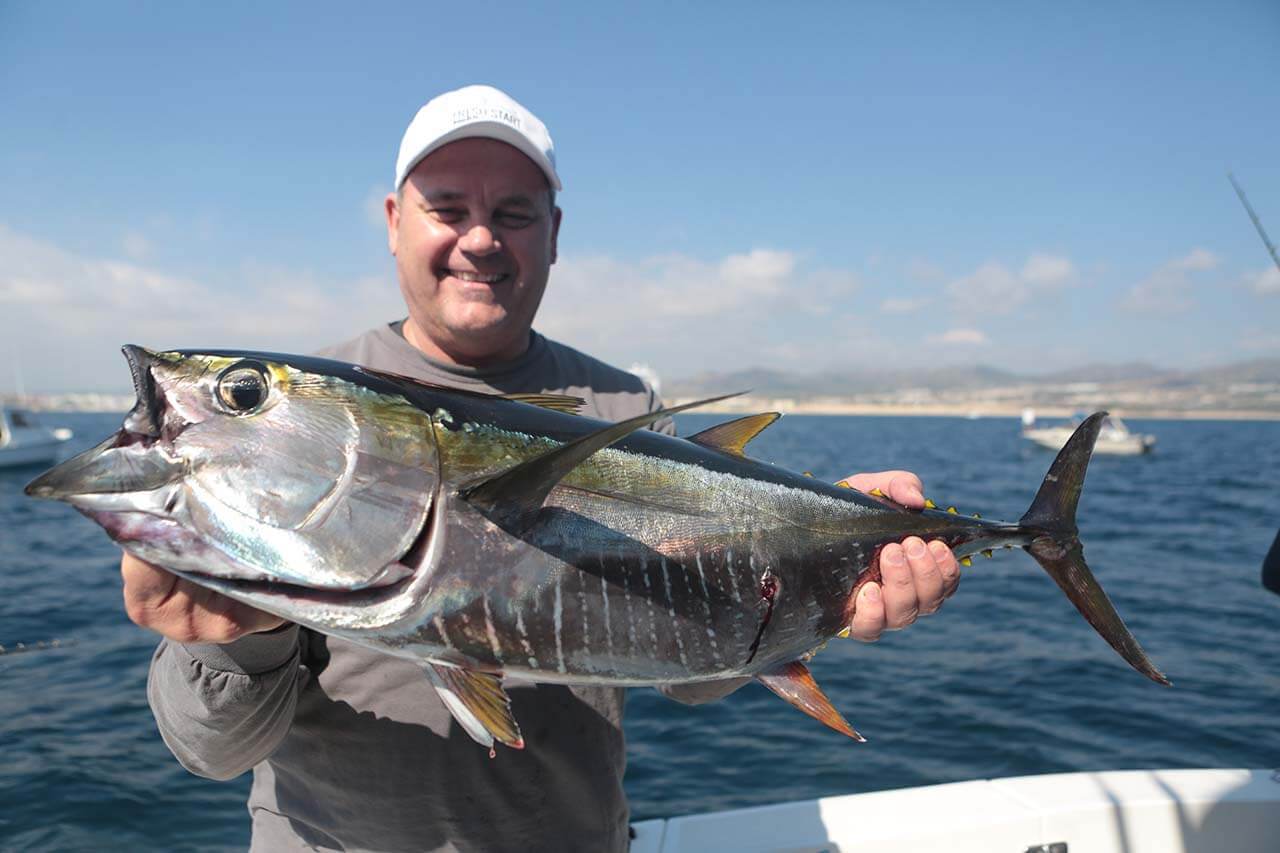
For anglers researching Cabo tuna fishing October, the attraction is easy to understand because October brings warm offshore water, active bait populations and excellent opportunities to pursue one of the strongest game fish found around Cabo San Lucas. Yellowfin tuna combine speed, endurance and raw pulling power, creating a completely different fishing experience from the aerial displays associated with marlin and dorado. When a strong yellowfin takes a bait or trolling lure and begins stripping line from the reel, even experienced offshore anglers quickly understand why tuna fishing has developed such a loyal following in Cabo.
October is particularly appealing because yellowfin tuna can be part of a much broader offshore ecosystem that also includes blue marlin, striped marlin, dorado, wahoo and sailfish. The challenge is that tuna are highly mobile predators, so successful fishing requires much more than traveling to a predetermined location and putting lines in the water. Captains need to interpret water conditions, locate bait, watch for birds and porpoise, evaluate currents and use recent fishing information to determine where yellowfin are most likely to be feeding.
Blue Sky Cabo Fishing and Tours approaches October tuna fishing with that mobility in mind. Private five-, six-, eight- and ten-hour charters allow guests to select a trip that matches their objectives, although anglers specifically interested in yellowfin should carefully consider the additional range provided by an eight- or ten-hour charter. Productive tuna activity can sometimes be relatively close to Cabo San Lucas, while on other days the search can extend approximately 40 miles offshore, making available fishing time and travel range important parts of the booking decision.
October Brings Cabo Offshore Fishing into a Productive Tuna Period
October sits within an exciting portion of the Cabo sportfishing calendar because warm Pacific water can continue supporting the bait and pelagic activity that attract yellowfin tuna. Seasonal timing is valuable when planning a vacation, but the calendar should always be considered a starting point rather than a guarantee. Tuna follow food and favorable ocean conditions, which means their exact location can change dramatically as currents move, bait concentrations shift and offshore conditions develop.
This is why experienced Cabo captains spend so much time reading the ocean rather than simply relying on historical fishing locations. A productive tuna area from the previous afternoon may still hold fish the next morning, but there is no reason to assume that it will. Yellowfin can travel significant distances, and the bait they are following can move just as quickly. Captains therefore combine historical knowledge with what they actually observe during the charter, allowing the day’s conditions to guide the strategy.
October’s advantage is the number of possibilities available within the broader offshore fishery. If yellowfin are present and actively feeding, the crew can concentrate on them, while a private charter also gives guests the flexibility to consider dorado, wahoo or billfish opportunities encountered during the search. For customers who want tuna above everything else, communicating that priority before departure helps the captain shape the day around the target.
Yellowfin Give Cabo October Fishing Serious Offshore Power
Yellowfin tuna are built for speed and endurance, and their body design allows them to apply sustained pressure in a way that surprises many first-time anglers. Unlike a marlin that may spend part of the fight jumping across the surface, a tuna can use the water column to its advantage, making powerful runs before settling into a deep battle beneath the boat. As the fish tires, it may begin circling below the angler, forcing the fisherman to maintain steady pressure while slowly recovering line.
The physical nature of the fight makes proper technique important. Anglers should listen carefully to the deck crew, maintain appropriate pressure and use the rod and reel efficiently rather than trying to overpower the fish with their arms. A strong yellowfin can expose poor technique quickly, while a first-time angler following good instructions can successfully handle a fish that initially appears intimidating.
This combination of strength and accessibility makes yellowfin attractive to a broad range of Cabo visitors. Experienced anglers appreciate the challenge of larger tuna, while beginners often discover that the fight becomes manageable once they understand how to use the equipment correctly. A private charter also allows the crew to provide individual instruction without having to balance the needs of unrelated passengers.
Porpoise Help Cabo Captains Locate October Tuna Fishing
One of the most interesting parts of yellowfin fishing around Cabo is the relationship that can develop between tuna and porpoise schools. Yellowfin may travel beneath or around moving porpoise, making those groups an important offshore clue for experienced captains. When porpoise are located, the captain and crew begin looking more closely at bird behavior, bait activity and other signs that might indicate tuna are feeding in the same area.
The presence of porpoise alone does not guarantee that yellowfin are underneath them, which is why experience remains important. A crew may work a porpoise school and determine that the conditions are not producing tuna, while another group encountered later in the day may immediately reveal feeding fish. The ability to investigate, evaluate and then move when necessary is an important part of successful offshore searching.
For guests aboard the boat, this process can make the charter much more interesting once they understand what the crew is watching. What initially appears to be an enormous expanse of featureless Pacific water begins revealing patterns, including birds changing direction, porpoise gathering, bait appearing near the surface and areas where water color or current changes. Tuna fishing becomes a search based on evidence rather than a simple run to a fixed destination.
Working Birds Give Cabo Tuna Fishing Crews Valuable Information
Bird activity can provide another important clue when searching for October yellowfin. Predatory fish frequently force bait toward the surface, where seabirds can take advantage of the feeding opportunity from above. A concentrated group of birds repeatedly diving into the same area deserves attention because something beneath the surface may be driving that activity.
Experienced captains learn to distinguish between casual bird movement and behavior worth investigating. Several birds circling high above an area may cause the captain to change course, while aggressive diving activity can produce a much faster response from the crew. As the boat approaches, the crew may prepare trolling equipment, live bait or other presentations depending on what they observe.
The relationship between birds, bait and predators demonstrates why tuna fishing requires constant observation. Electronics provide valuable information, but experienced eyes remain essential because many of the most useful clues occur at the surface. A captain who combines onboard technology with visual observation has more information available when deciding where to invest valuable charter time.
Bait Concentrations Shape Cabo October Fishing Success
Yellowfin tuna cannot remain in an area without a reason, and food is usually the strongest reason for predators to stay. Bait concentrations can include sardines, mackerel, squid, flying fish and other forage depending on the location and conditions. When currents gather bait into productive water, yellowfin and other pelagic predators may concentrate around the same feeding opportunity.
This explains why an October date alone cannot predict exactly where the tuna will be found. Seasonal conditions may be favorable across a broad area, but the captain still needs to identify where the most productive combination of bait, current and predator activity has developed. The location may change during the week, during the day or even while the boat is fishing.
For anglers planning an October charter, the best approach is therefore to select an experienced crew and provide enough fishing time for that crew to search effectively. A rigid expectation that tuna must be found at one named bank or a particular distance from the marina can work against the reality of offshore fishing, where mobility is often one of the most important characteristics of the target species.
Kite Presentations Add Excitement to Cabo Tuna Fishing
Kite fishing is one of the specialized techniques that can be used when conditions are appropriate for yellowfin tuna. The objective is to create a natural surface presentation while reducing the amount of visible terminal tackle immediately surrounding the bait. When everything comes together, a tuna may attack the bait at the surface, producing one of the most dramatic strikes available in offshore fishing.
Blue Sky Cabo can incorporate tuna kite and helium-supported techniques when the captain and crew determine that they fit the conditions. Kite fishing is not automatically used simply because yellowfin are the target, since wind, sea conditions, fish behavior and bait availability all influence whether the technique makes sense on a particular day.
The larger lesson is that a quality tuna operation should have multiple tools available rather than depending on a single presentation. Tuna behavior changes, and the technique that works during the morning may become less effective later in the day. Having trolling equipment, live bait, cedar plugs, spinning tackle and specialized kite options gives the crew greater flexibility to respond to the fish instead of expecting the fish to respond to one method.
Cedar Plugs Give Cabo October Fishing a Proven Tuna Technique
Cedar plugs remain a proven part of offshore tuna fishing because they provide a straightforward presentation that can be extremely effective when pulled through productive water. Their simplicity should not be mistaken for a lack of sophistication, since generations of offshore anglers have relied on them while searching for yellowfin. Trolling cedar plugs and other tuna presentations allows the boat to cover water while the captain continues searching for birds, porpoise, bait and favorable current conditions. A strike can provide immediate information that fish are present, while multiple bites may encourage the captain to work the area more thoroughly or transition to another technique.
This ability to move between searching and actively working a school is particularly valuable in October, when several pelagic species may occupy the same general offshore environment. A trolling spread intended for tuna can sometimes attract another species, and the crew needs to remain prepared for whatever enters the spread.
Live Bait Gives Cabo Tuna Fishing Greater Flexibility
Live bait is another important component of yellowfin fishing and is included on Blue Sky Cabo charters. When tuna are located and willing to feed, a properly presented live bait can create opportunities that are very different from trolling. The crew evaluates the fish’s behavior and determines when bait fishing should become part of the strategy. Boat position, timing and presentation all matter. Simply throwing bait into the ocean without a plan does not produce the same results as positioning the boat correctly around active fish and presenting bait naturally. When several tuna begin feeding at the same time, the cockpit can quickly become busy, making crew organization especially important.
Guests should follow instructions closely during multiple hookups because tuna can change direction and cross lines as they fight. An experienced deck crew works to keep anglers separated, manage unused equipment and maintain order so that several opportunities do not become tangled together.
Offshore Range Makes Cabo October Fishing Time Important
One of the most important considerations for anyone booking a tuna-specific charter is offshore range. Yellowfin are not obligated to remain near Cabo San Lucas Marina, and productive activity may develop many miles offshore. Blue Sky Cabo’s operating experience can involve traveling approximately 40 miles in search of tuna when conditions and recent activity justify making the run.
That distance changes the practical value of charter duration because travel time must be counted in both directions. A boat that runs a significant distance offshore still needs enough time to fish effectively before beginning the return to Cabo. This is why serious tuna anglers should think beyond the advertised number of charter hours and consider how much of that time could realistically be available for searching and fishing.
Longer charters do not guarantee better catches, but they provide the captain with additional range and strategic options. When the target species is as mobile as yellowfin tuna, those options can become extremely valuable.
Five-Hour Cabo Charters Can Produce October Tuna Fishing
A five-hour charter can absolutely produce yellowfin when fish are accessible within the available range. For families, first-time anglers and visitors who want fishing to occupy only part of the vacation day, a shorter trip can provide an enjoyable introduction to Cabo offshore fishing.
The limitation is not the quality of the charter but the amount of time available. If the strongest tuna activity is far offshore, the captain cannot extend a five-hour schedule into a long-range trip without affecting the agreed return time. Guests choosing a shorter charter should therefore remain flexible about species and allow the captain to recommend the strongest opportunity available within the practical range.
When tuna are relatively close, a five-hour charter can become extremely productive. When they are distant, another species may represent a better use of the fishing day.
Six-Hour Cabo Charters Expand October Fishing Options
- Six hours provides additional searching time and range without requiring guests to spend the entire day offshore. For many vacationing anglers, this creates a useful balance between serious fishing and the other activities planned during a Cabo vacation.
- The extra time gives the captain more flexibility to investigate developing activity or move away from an unproductive area. If birds or porpoise are located farther from the initial fishing grounds, an additional hour can sometimes make a meaningful difference.
- However, guests whose primary objective is specifically yellowfin tuna should still discuss recent offshore distances before selecting the charter length. When tuna activity has consistently been developing farther offshore, eight or ten hours can provide a better match for the goal.
Eight-Hour Cabo Charters Give Tuna Fishing More Range
- An eight-hour charter provides considerably more freedom for serious yellowfin fishing. The captain can cover additional water, investigate more offshore activity and make meaningful changes in location without immediately becoming constrained by the return schedule.
- This flexibility becomes especially important when the first plan does not work. Tuna fishing frequently requires adaptation because yesterday’s productive area can become quiet after currents or bait move. With eight hours available, the captain has more opportunity to abandon an unproductive zone and search somewhere else.
- For anglers traveling to Cabo with yellowfin high on the priority list, an eight-hour trip offers a strong combination of offshore range and practical charter duration. It allows the crew to approach the day as a serious search rather than being forced to remain close to the marina.
Ten-Hour Cabo Charters Maximize October Fishing Possibilities
A ten-hour charter provides the greatest amount of searching time and offshore range available within Blue Sky Cabo’s standard charter options. Dedicated tuna anglers may find this particularly valuable when recent yellowfin activity has developed far from Cabo or when the objective is to give the captain as much strategic flexibility as possible. The additional hours can be used for a longer initial run, investigating several areas or remaining with productive fish after they are finally located. If the first porpoise school does not hold tuna, there is more time to continue searching, and if the bite develops later in the day, the charter is less likely to end just as conditions become productive.
It remains important to understand that purchasing ten hours does not purchase a guaranteed tuna. What it provides is time, range and flexibility, which are three extremely useful assets when pursuing a highly mobile offshore species.
Offshore Banks Influence Cabo October Fishing Strategy
Areas such as the Gordo Banks and other offshore structures are well known within the Los Cabos fishing community because current interacting with underwater structure can create productive conditions. These locations can become relevant to tuna fishing, but experienced captains do not assume that a famous bank will automatically hold fish on a particular day. Yellowfin follow favorable conditions and food rather than the name attached to a location. If bait moves away from a bank or stronger feeding activity develops somewhere else, the captain needs to be willing to follow the evidence.
This is another reason guests benefit from allowing the captain to make tactical decisions. A visitor may have read that tuna were caught at a particular location several days earlier, but the crew has access to more recent information and can evaluate what is actually happening on the water.
Choosing a Cabo Boat Improves October Tuna Fishing Comfort
Blue Sky Cabo Fishing and Tours operates private sportfishing boats ranging from 32 to 60 feet, allowing guests to select a vessel that matches group size, desired comfort and fishing objectives. The fleet includes the 32′ Luhrs Blue Star, 35′ Riviera Blue Water, 43′ Riviera Blue Sky, 50′ Viking Blue Ocean and 60′ Bertram Blue Sea.
Smaller groups may prefer the traditional sportfishing experience offered by the 32- or 35-foot boats, while larger groups may value the additional room and amenities available aboard the larger vessels. Comfort becomes increasingly important as charter duration and offshore travel increase, particularly when guests are considering eight- or ten-hour tuna trips. The 43-, 50- and 60-foot boats also provide Starlink connectivity, adding another convenience for guests who want to remain connected while offshore. The best boat is not automatically the largest vessel in the fleet, because the correct choice depends on the number of guests, fishing objectives, preferred amenities and budget.
Experienced Crews Strengthen Cabo Tuna Fishing Strategy
Yellowfin fishing places significant responsibility on the captain and crew because the day’s strategy can change repeatedly. The captain may begin by trolling toward an area where tuna were recently reported, then divert toward working birds, investigate a porpoise school and eventually switch to live bait or kite fishing once active fish are located. The deck crew must be equally adaptable because equipment and presentations can change quickly. Rods need to be prepared, leaders checked, bait managed and the cockpit kept organized when several anglers are fighting fish.
Blue Sky Cabo maintains established captain-and-boat assignments rather than routinely moving captains between vessels. Familiarity with the boat’s handling, electronics, fishing equipment and regular crew helps create consistency, particularly during situations where several tuna are hooked and decisions need to be made quickly.
Fishing Equipment is Included with Cabo October Tuna Charters
Guests booking with Blue Sky Cabo do not need to purchase offshore fishing equipment before traveling. Fishing equipment, fishing licenses and live bait are included, allowing first-time visitors to arrive without transporting rods, reels and terminal tackle through airports. Depending on the day’s strategy, tuna equipment can include trolling tackle, live-bait setups, spinning equipment, cedar plugs and specialized kite presentations. The crew selects equipment according to the fish, conditions and technique rather than using one setup for every situation.
Experienced anglers remain welcome to bring personal rods, reels and specialized tackle. Any personal equipment should be discussed with the captain and crew before fishing begins so that it can be incorporated safely into the overall spread without interfering with the boat’s established strategy.
Yellowfin Add Excellent Table Value to Cabo October Fishing
Yellowfin tuna are valued both as game fish and as quality table fare, giving anglers another reason to pursue them during an October charter. Blue Sky Cabo allows legal-quality yellowfin to be retained when guests want fish for the table, while conservation policies differ for species such as marlin and roosterfish, which are released.
The decision to retain a legal tuna should still involve responsible handling and sensible harvest. Catching a quality fish can provide memorable meals during or after a Cabo vacation without requiring every fish encountered to be kept.
This balanced approach allows guests to enjoy the culinary value of yellowfin while supporting responsible fishing practices across the broader range of species encountered around Cabo.
Photography Adds Value to Cabo October Fishing Memories
Blue Sky Cabo provides complimentary photos and video on every charter, including Cabo Arch photos, which allows guests to document the experience without spending the entire fishing day looking through a phone screen. This becomes particularly valuable during a tuna fight because the angler needs to concentrate on maintaining pressure and following crew instructions.
A strong yellowfin bending the rod deeply while the angler works around the cockpit can produce outstanding photographs and video. The final moments when the fish becomes visible below the boat are also worth documenting, particularly after a demanding fight.
Guests are welcome to bring their own cameras and phones, but having the charter documented provides another layer of value and allows everyone to remain more involved in the actual fishing experience.
October Demand Makes Cabo Tuna Fishing Reservations Important
October is one of Cabo’s most active sportfishing periods, and tournament activity can increase demand for premium boats and longer charter durations. Anglers who already know their October travel dates should therefore avoid assuming that their preferred boat will remain available until shortly before arrival.
Blue Sky Cabo recommends booking approximately two to three months in advance during high-demand periods. Early booking gives clients a stronger opportunity to select the preferred date, boat and charter duration instead of accepting whatever remains available.
This becomes especially important for tuna anglers who want an eight- or ten-hour trip, since longer charters can be particularly valuable when yellowfin are being found at greater offshore distances. Booking early allows the client to shape the fishing day around the objective rather than changing the objective around remaining availability.
Flight Planning Protects Cabo October Fishing Reservations
An important fishing charter should not be scheduled for the same day a guest arrives in Cabo because flight delays, immigration processing, baggage collection and airport transportation can all create uncertainty. A better plan is to arrive, settle into the hotel or villa and schedule fishing for the following day or later in the vacation. If an unexpected flight delay threatens an existing charter, guests should contact Blue Sky Cabo immediately. The team can determine whether another departure or fishing date is available, although rescheduling always depends on existing reservations and cannot automatically be guaranteed.
This becomes especially important during October because high demand can leave fewer alternative openings. Building flexibility into the vacation schedule protects an important fishing day before travel even begins.
Weather Remains Important for Cabo Offshore Fishing
October remains within the broader eastern Pacific tropical-weather period, which makes responsible marine-weather monitoring essential. Conditions visible from a Cabo resort do not necessarily represent what a boat may encounter many miles offshore, particularly when tuna fishing requires traveling substantial distances.
Wind, swell and developing tropical systems can all influence offshore decisions. Blue Sky Cabo vessels carry important safety equipment including life jackets, life rafts and EPIRBs, while larger vessels also provide Starlink connectivity.
The captain and company evaluate marine conditions with safety as the priority. Yellowfin may be an exciting target, but no fishing opportunity justifies operating irresponsibly when conditions are unsuitable.
Other Species Expand Cabo October Fishing Opportunities
A charter that begins with yellowfin as the primary objective can still encounter several other desirable species during October. Blue marlin can remain active in warm offshore water, striped marlin can become increasingly relevant as seasonal conditions transition, dorado may gather around productive current lines and floating structure, and wahoo can add another high-speed predator to the offshore mix.
This diversity is one of the strongest reasons October attracts anglers to Cabo. A group can remain completely committed to tuna or tell the captain that the best available action is more important than one specific species. Because Blue Sky Cabo charters are private, that decision belongs to the group. Clear communication before departure allows the captain to understand whether yellowfin are the absolute priority or whether the guests would rather take advantage of whatever high-quality opportunity the Pacific provides
Booking Blue Sky Cabo for October Tuna Fishing
Planning Cabo tuna fishing October should begin with realistic expectations about how yellowfin behave. These fish are powerful, highly mobile predators that follow bait and productive ocean conditions, which means their location cannot be reduced to one bank, one GPS coordinate or one guaranteed distance from Cabo San Lucas Marina. The strongest charter strategy is to give an experienced captain enough time and range to search effectively while remaining flexible about the techniques required once fish are located. Birds, porpoise, bait concentrations, current movement and recent activity all contribute information, while trolling, cedar plugs, live bait and specialized kite presentations give the crew multiple ways to respond.
Blue Sky Cabo Fishing and Tours offers private five-, six-, eight- and ten-hour charters aboard boats ranging from 32 to 60 feet, with fishing licenses, live bait and fishing equipment included. Complimentary photos and video are provided on every charter, including Cabo Arch photos, and experienced anglers remain welcome to bring personal fishing equipment when desired. For dedicated yellowfin anglers, eight- and ten-hour trips provide additional offshore range that can become particularly valuable when tuna are located farther from Cabo. During busy October periods, booking approximately two to three months ahead also gives clients a better opportunity to secure the preferred boat, date and charter duration.
October provides the seasonal opportunity, but successful tuna fishing still depends on finding the right water, locating the bait and responding intelligently to what the ocean presents that day. When the captain finally finds active yellowfin and a reel begins losing line under heavy pressure, the searching becomes part of the story rather than wasted time, and the reason anglers return to Cabo to pursue these powerful fish becomes immediately clear.
Blue Sky Cabo Fishing and Tours
F Dock, IGY Marina, Cabo San Lucas, B.C.S., Mexico
Cell / WhatsApp: +1 480-635-2965
