
Cabo Fishing Report – Blue Sky Cabo Fishing Charters
September 12, 2026 – Marlin, Wahoo and Big Yellowfin Tuna Between Los Arcos and Diamante
Date: Saturday, September 12, 2026
Boat: Blue Sky – 43′ Riviera
Captain: Luis
Guests: Nathan, Lauren, Megan, Paul, Mark and Paul
Charter Length: 10 Hours
Charter Time: 6:00 AM – 4:00 PM
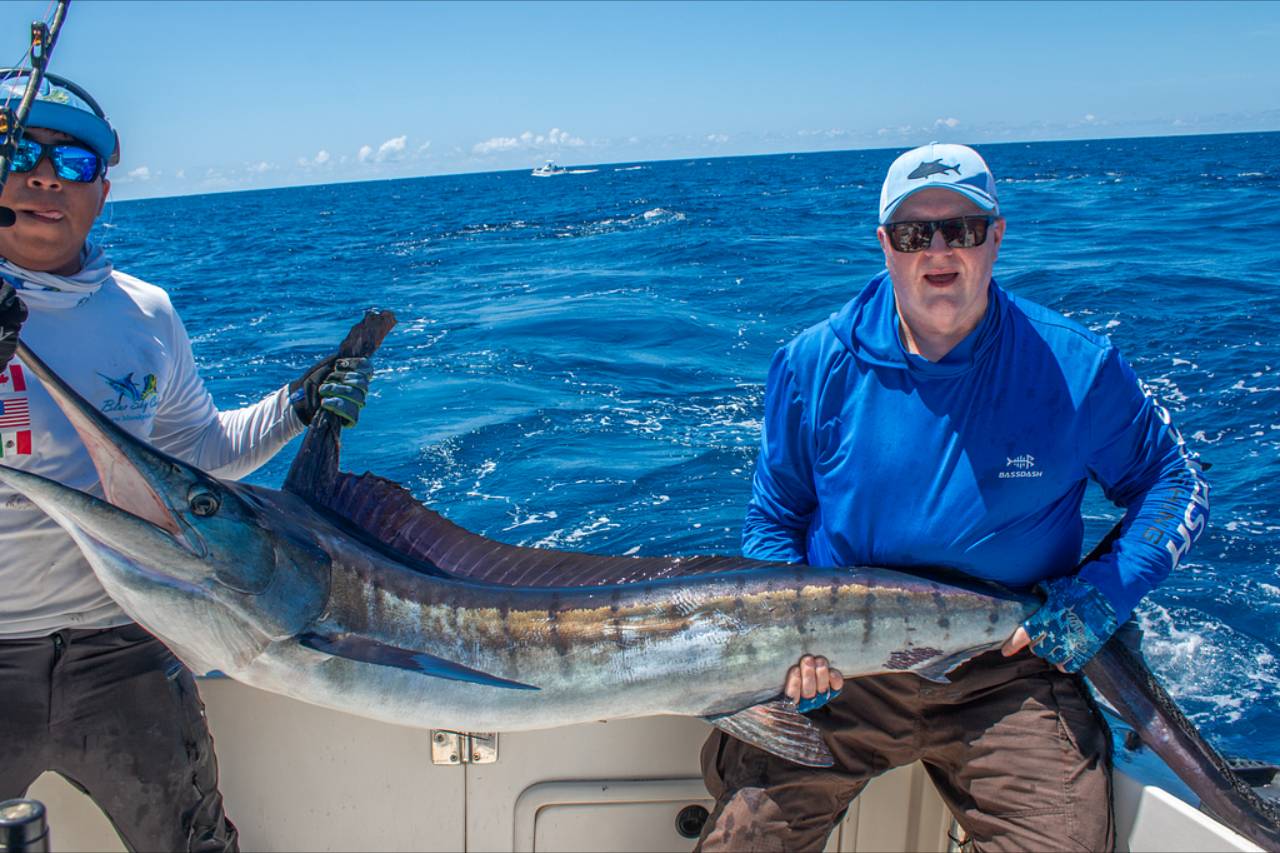
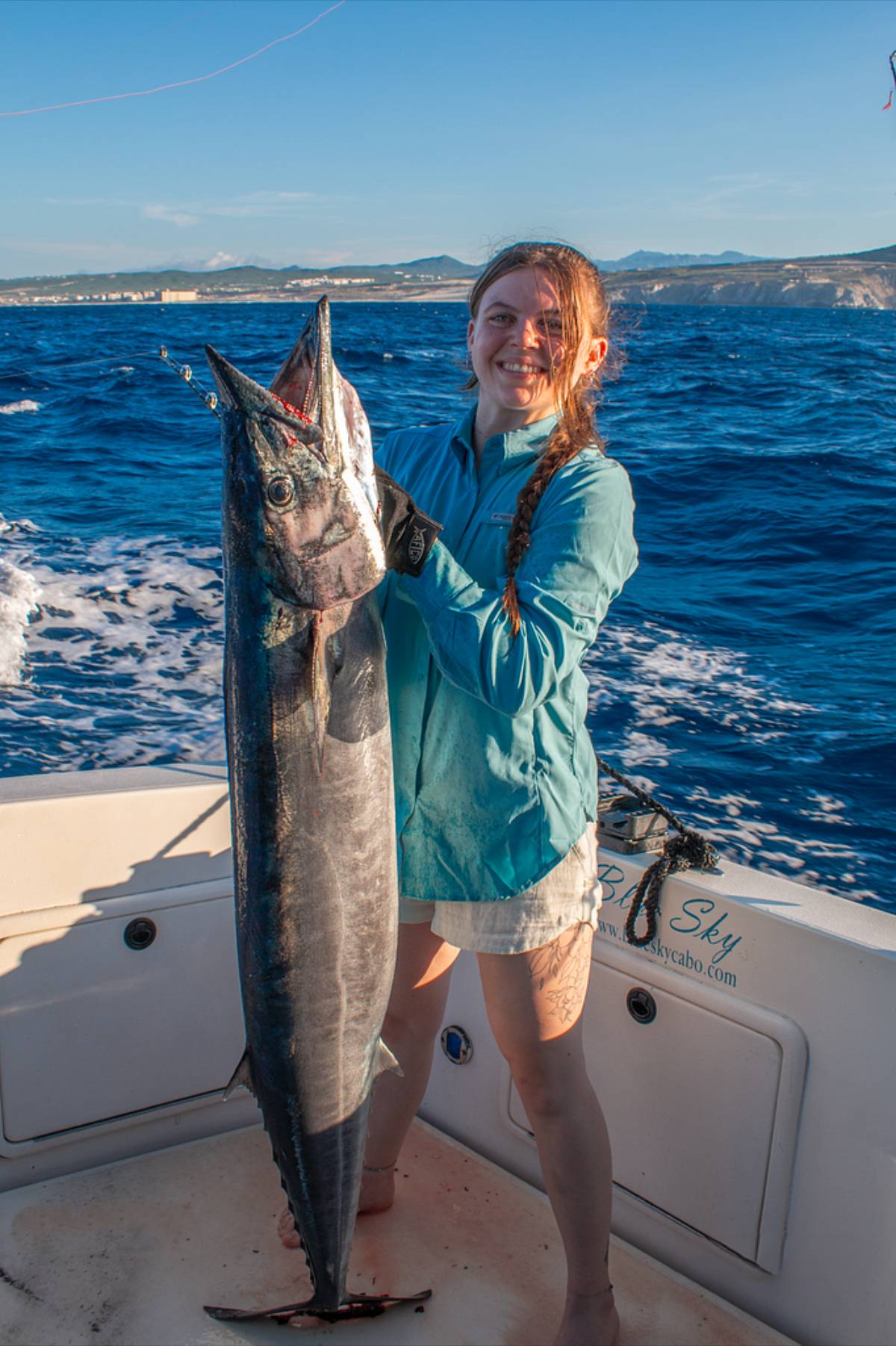
Catch: 1 Marlin, 1 Wahoo, 1 Large Yellowfin Tuna
Total Game Fish: 3
Released: 1 Marlin
Kept: 1 Wahoo, 1 Yellowfin Tuna
Fishing Location: Los Arcos to the Diamante area, Pacific side of Cabo San Lucas
Trip Type: Private offshore Cabo fishing charter
Fishing Method: Offshore trolling with dredge presentation
Dredge: Yes
Primary Species: Marlin, wahoo and yellowfin tuna
September fishing in Cabo San Lucas can produce days when one species dominates the action, but some of the most interesting charters are those when the Pacific delivers completely different predators during the same trip. That was the story on September 12, 2026, when Nathan, Lauren, Megan, Paul, Mark and Paul spent a full day fishing the Pacific side and finished with a marlin, wahoo and large yellowfin tuna while working the waters between Los Arcos and the Diamante area.
Captain Luis concentrated on a section of the Pacific that gave the crew access to changing water, offshore structure and the possibility of encountering several pelagic species. The dredge was incorporated into the trolling presentation, helping create the appearance of a concentrated group of bait moving beneath the surface while the boat searched for predators. Instead of producing a single-species bite, the area delivered three fish that represent very different sides of Cabo sportfishing.
The marlin provided the classic billfish experience and was successfully released, while the wahoo brought the speed and sudden aggression for which the species is known. The large yellowfin tuna completed the day with a completely different battle built around sustained power and endurance. For anglers researching September fishing in Cabo San Lucas, the trip provides an excellent example of why this period can be so appealing to visitors who want variety rather than concentrating exclusively on one target.
Three Major Offshore Species Define a Diverse September Fishing Charter
A marlin, wahoo and yellowfin tuna could hardly be more different in the way they behave around a fishing boat, which made this particular catch especially interesting. Each species required a different response from the crew and gave the anglers a different experience, even though all three were encountered during the same 10-hour charter.
Marlin are naturally associated with Cabo San Lucas because billfish have played such an important role in building the destination’s international sportfishing reputation. Their appearance around a trolling spread can change the atmosphere aboard a boat immediately, particularly when a fish becomes interested in a teaser or bait and begins working close enough to be seen clearly. The excitement comes not only from the fight but from watching the encounter develop before the hookup occurs.
Wahoo approach offshore fishing very differently. Their streamlined bodies are built for speed, and a strike can happen so quickly that the first indication of a fish may be a reel suddenly losing line at an extraordinary rate. Their acceleration, sharp teeth and unpredictable appearance make them one of the most exciting species encountered around Cabo, particularly when they interrupt a trolling pattern originally intended for another predator.
The large yellowfin tuna added the third dimension to the charter because tuna rely less on surface spectacle and more on relentless strength. Once a substantial yellowfin settles below the boat, the fight can become a demanding contest in which the angler has to maintain steady pressure while taking advantage of every opportunity to recover line.
Experiencing those three styles of fishing during one charter created a far more varied day than the final number of three game fish might initially suggest.
Los Arcos and Diamante Produced a Productive Pacific-Side Fishing Zone
The fishing location is an important part of this Cabo fishing report because the waters between Los Arcos and the Diamante area can provide access to a broad range of Pacific conditions without requiring the crew to commit to one fixed offshore destination. On September 12, that flexibility became valuable because the catch developed across three species rather than around one concentrated school of fish.
Experienced Cabo captains do not simply select a coordinate in the morning and assume the fish will still be there. Offshore conditions change continuously as currents move, bait shifts and productive water develops in different areas. Surface activity, bird movement, baitfish, water clarity and current lines can all influence whether the boat remains on its original course or adjusts the fishing pattern. The Los Arcos–Diamante zone provided Captain Luis with room to work those conditions while maintaining a trolling presentation capable of attracting different pelagic predators. This was particularly useful on a September day when warm Pacific water created the possibility of encountering marlin, wahoo and tuna within the same broader fishing area.
For visitors researching where to fish in Cabo San Lucas, this is an important distinction. Famous fishing grounds provide useful geographic references, but offshore fishing is not based on simply driving to a named location and waiting for fish to appear. The more important skill is recognizing productive water and understanding when the signs justify staying in an area.
Dredge Fishing Added a Strong Visual Element to the Offshore Spread
The dredge was an important part of the fishing setup during this charter and deserves to be included in the historical record because it explains something about how the crew approached the day rather than simply documenting what was caught.
A properly presented dredge creates the visual appearance of multiple baitfish traveling beneath and behind the boat. Instead of a predator seeing only an individual lure or bait, it encounters a much larger underwater scene that can resemble a concentrated group of forage moving through the water. For a marlin or another pelagic predator traveling through open ocean, that additional visual activity can help attract attention toward the boat and the fishing spread.
The effectiveness of a dredge should never be separated from the larger fishing strategy, however, because no teaser can compensate for fishing unproductive water. Captain and crew still have to locate an area holding predators, maintain the trolling pattern and position the boat effectively once a fish shows interest. The dredge is therefore best understood as one component within a complete offshore presentation.
On September 12, that presentation was being worked through Pacific water capable of holding several different predators, and the resulting catch reflected the diversity of the area. The equipment did not determine which species would appear, but it contributed to a trolling program that ultimately generated opportunities with marlin, wahoo and yellowfin tuna.
The Marlin Release Continued Cabo’s Strong Billfish Tradition
Cabo San Lucas and marlin fishing have been connected for generations, and catching a billfish remains one of the primary goals for many visitors booking a private fishing charter. The marlin encountered on this trip added that traditional Cabo experience to a day that would eventually become much broader than billfishing alone.
A marlin encounter can develop gradually as a fish follows the spread and investigates the presentation, or it can happen with very little warning. Once the fish commits, the crew has to respond quickly while the captain manages the boat and the angler settles into the fight. Every fish behaves differently, which is one reason experienced anglers continue to find billfishing exciting even after multiple successful catches. The marlin from this charter was successfully released rather than brought back to the marina, consistent with Blue Sky Cabo’s approach to billfish conservation. Catch-and-release allows guests to experience the complete challenge of finding, hooking and fighting a marlin while returning the fish to the Pacific afterward.
That release became especially meaningful because the charter also produced species that could be retained. The combination created a balanced offshore day in which the guests experienced the excitement of catching one of Cabo’s iconic billfish while still having the opportunity to keep quality table fish.
Wahoo Added Speed and Unpredictability to the Cabo Fishing Report
Wahoo occupy a special place in offshore fishing because they can transform a quiet trolling pattern into immediate action with almost no warning. Their speed is one of their defining characteristics, and their initial run often provides the first clear indication that something very different has entered the spread.
The species is also distinctive because its long, narrow body and powerful tail are designed for rapid acceleration, while its sharp teeth demand careful handling once the fish reaches the boat. These characteristics make a successful wahoo catch memorable even on a charter that also includes larger or more famous game fish. For anglers researching wahoo fishing in Cabo San Lucas, actual daily fishing reports are particularly useful because wahoo availability can fluctuate with seasonal water conditions and bait movement. A generalized Cabo fishing calendar can identify periods when wahoo may be encountered, but it cannot describe exactly where or when an individual fish will appear.
This September 12 report provides that real-world context by recording a wahoo caught while working the Pacific side between Los Arcos and Diamante. The fish became part of a mixed offshore catch rather than the sole target of the day, demonstrating why crews have to remain prepared for unexpected species while trolling productive water.
A Large Yellowfin Tuna Brought Power to an Already Varied Fishing Day
The yellowfin tuna completed the three-species catch and gave the anglers a fight that contrasted sharply with both the marlin and wahoo. Larger yellowfin are respected because of the sustained pressure they can generate once hooked, particularly when they settle deeper in the water column and begin using their strength below the boat. Tuna fights frequently become battles of technique and patience rather than dramatic surface displays. The angler has to maintain pressure without wasting energy, use the tackle effectively and recover line whenever the fish allows it. As a yellowfin tires, the fight may settle into deep circles, with each revolution creating another opportunity to gradually bring the fish closer to the surface.
Landing a big tuna after that type of battle provides a different sense of accomplishment from successfully releasing a marlin. It is physically demanding, and the quality of yellowfin as table fare adds another dimension to the catch once the fishing is finished.
Yellowfin tuna around Cabo can move considerably according to bait availability and ocean conditions, which is why their presence should never be treated as automatic during any particular month. On September 12, however, the Pacific produced a quality tuna in the same broader area that also held marlin and wahoo, reinforcing the value of maintaining a flexible fishing strategy.
September Fishing in Cabo Can Reward Anglers Who Want Species Variety
One of the advantages of fishing Cabo during September is the possibility of encountering several warm-water pelagic species during the same trip. Although no combination can ever be guaranteed, the seasonal conditions can create an interesting overlap in which marlin, dorado, tuna, wahoo and sailfish may all be realistic possibilities depending on the movement of bait and productive water.
This is particularly appealing to anglers who prefer a mixed offshore experience rather than dedicating the entire charter to one species. Someone may leave Cabo hoping primarily for a marlin but still be thrilled when a wahoo enters the spread, while another guest interested in tuna may suddenly find themselves connected to a billfish. The September 12 charter illustrates that flexibility extremely well because the day never had to be defined by a single target. Instead, the Pacific produced three major game-fish species, with each encounter adding something different to the experience.
Historical fishing reports become especially valuable in months like September because they document the actual species mix rather than simply repeating a list of fish that are theoretically in season. Over several years, those reports can help anglers understand how much variation exists even among charters taking place within the same week.
A Ten-Hour Cabo Fishing Charter Gives the Captain More Room to Adapt
Charter duration played an important role in this trip because a 10-hour day gives the captain considerable flexibility to let the fishing develop according to the conditions rather than forcing every decision into a short window.
Longer fishing time does not guarantee additional fish, and it should never be promoted as though buying more hours automatically purchases a larger catch. What those additional hours provide is more opportunity to search, investigate productive signs, change areas when necessary and remain with a developing bite without immediately worrying about the return schedule. This becomes particularly valuable on a multi-species trip. If marlin are showing in one area while signs of tuna appear elsewhere, a longer charter provides more freedom to adjust the plan. If the first few hours are slower than expected, the crew still has time to locate another productive section of water rather than having to turn toward the marina.
For anglers comparing different Cabo fishing charter lengths, the decision should therefore be based on the experience they want. Five or six hours may be appropriate for visitors looking for a shorter day, while eight hours provides a traditional offshore charter. A 10-hour trip is well suited to serious anglers who want to give the captain maximum flexibility to respond to changing conditions.
On September 12, that extended fishing window complemented the diverse Pacific bite and allowed the charter to develop into a complete multi-species day.
Cabo Fishing Conditions Matter More Than Yesterday’s Coordinates
- One of the most important lessons in offshore fishing is that fish do not remain stationary simply because they were caught in a particular location the previous day. Productive water can shift overnight as currents change, bait moves and predators follow the conditions that provide the best feeding opportunities.
- This is why an experienced captain pays attention to what is happening during the charter rather than relying exclusively on historical coordinates. Yesterday’s report provides valuable information, but today’s ocean still has to be read independently.
- The area around Los Arcos and Diamante can look entirely different from one day to another. A section that produced marlin may become more active with dorado, while tuna can appear where very little surface activity was visible the previous morning. Wahoo may arrive unexpectedly during a trolling pattern designed primarily for another species.
- Daily Cabo fishing reports are useful because they preserve those changes. Instead of suggesting that one fishing ground is permanently productive, they create a chronological record showing how species and locations shift throughout the season.
- The September 12 report now provides one more point in that historical record: marlin, wahoo and a large yellowfin tuna were encountered while working the Pacific side between Los Arcos and the Diamante area.
A Multi-Species Catch Shows the Strength of Cabo’s Pacific Fishery
Cabo San Lucas has become internationally recognized for marlin, but the broader strength of the fishery comes from the variety of pelagic predators that can move through the waters surrounding the southern Baja Peninsula.
The Pacific side can produce dramatically different fishing experiences depending on the season. One charter may revolve around striped marlin, while another becomes a dorado day. Yellowfin tuna can become the primary objective when productive schools are located, and wahoo add an unpredictable high-speed element when conditions bring them into the area.
This variety is particularly valuable for families and groups because not every guest boards the boat with the same fishing goal. One angler may have dreamed for years about catching a marlin, while another is more interested in landing a quality tuna or bringing fresh fish back from the charter. A mixed catch can satisfy both sides of the experience. On this September trip, the guests were able to participate in a classic Cabo billfish release while also landing two highly regarded offshore game fish that could be retained. The result was not simply three fish on the catch sheet but three distinctly different examples of what the Pacific fishery can offer.
Catch-and-Release and Selective Harvest Created a Balanced Offshore Experience
- The final catch also demonstrates how conservation and selective harvest can exist naturally within the same Cabo fishing charter.
- Blue Sky Cabo releases marlin, which meant the billfish was returned to the Pacific after the catch. The wahoo and yellowfin tuna, however, could be retained, providing the guests with the opportunity to enjoy part of their catch after the fishing day was complete.
- This approach makes sense for the type of mixed offshore fishing available around Cabo. Billfish can provide the signature sportfishing experience without needing to be brought back to the dock, while species such as tuna, wahoo, dorado, snapper and grouper can provide excellent table fare when retained responsibly.
- For visiting anglers, there is something particularly satisfying about experiencing both sides of that fishing culture during the same charter. The marlin release becomes a memorable conservation moment, while the tuna and wahoo connect the fishing experience with the culinary side of a Cabo vacation.
- The September 12 catch provided exactly that balance without requiring the report to exaggerate the numbers. Three game fish were enough to create a varied and memorable offshore day because each species contributed something completely different.
Why This Cabo Fishing Report Is About Variety Rather Than Numbers
- Three game fish may appear modest when viewed only as a number, but offshore fishing cannot always be measured accurately by counting tails. The species involved, the quality of the fish, the fishing conditions and the variety of experiences aboard the boat often tell a much more complete story.
- A marlin, wahoo and large yellowfin tuna during one charter represent three very different accomplishments. The billfish delivered the visual excitement and catch-and-release tradition associated with Cabo, the wahoo introduced one of the fastest predators in the ocean, and the tuna required the kind of sustained physical effort that makes a successful landing particularly rewarding.
- This is why a natural fishing report should explain the day rather than repeatedly restating the catch total. The statistics at the top preserve the permanent historical record, while the narrative provides the context necessary to understand why the trip was memorable.
- September 12 deserves its place in the Blue Sky Cabo fishing archive not because an enormous number of fish were brought alongside the boat, but because the Pacific produced an unusually complete cross-section of Cabo offshore fishing within a single day.
Final Cabo Fishing Report Summary – Marlin, Wahoo and Big Tuna off Los Arcos and Diamante
September 12, 2026 provided Nathan, Lauren, Megan, Paul, Mark and Paul with a genuinely varied day of Cabo sportfishing as Captain Luis worked the Pacific waters between Los Arcos and the Diamante area and produced three major offshore species during the 10-hour charter. The dredge formed part of the trolling presentation while the crew searched water capable of attracting different pelagic predators, and the resulting catch reflected exactly that diversity. A marlin delivered the signature Cabo billfish experience and was successfully released, a wahoo added speed and unpredictability to the day, and a large yellowfin tuna completed the charter with a powerful fight and an excellent fish to retain.
For anglers researching Cabo fishing in September, Cabo marlin fishing, Cabo wahoo fishing, Cabo yellowfin tuna fishing, Los Arcos fishing, Diamante fishing or private Cabo fishing charters, this report provides a useful historical example of how much variety can develop during one Pacific-side charter. It also demonstrates why experienced crews remain flexible rather than assuming the day will revolve around a single species.
The Pacific never promises that tomorrow will reproduce yesterday’s fishing, which is precisely why detailed reports matter. Each charter adds another piece to the historical picture, documenting where the boat fished, which species were encountered and how the conditions developed without turning one successful day into an unrealistic guarantee. For September 12, the historical record is straightforward: one marlin released, one wahoo and one large yellowfin tuna caught while fishing between Los Arcos and Diamante, creating an excellent three-species day and another distinctive entry in the Blue Sky Cabo fishing archives.
Blue Sky Cabo Fishing and Tours
Cell / WhatsApp: +1.480.635.2965
F Dock, IGY Marina, Cabo San Lucas, B.C.S., Mexico
